History of St. John's
St. John's Parish Community has fostered two American saints, caught fire twice (destroyed once),
withstood anti-Catholic riots, fed the hungry, educated poor children and adults, and served as the
proto-cathedral for the Diocese of Philadelphia. As the history below shows, we have always adapted
to the needs of God's people in whatever circumstances we find ourselves. At one point in the 19th
Century, we even had a 2:45 AM Mass for those who worked on the newspapers (the 'Printers Mass').
A Timeline:
December 27, 1830, Feast of St. John the Evangelist
Bishop Francis P. Kenrick, Third Bishop of Philadelphia, authorizes Rev.
John Hughes to build a new church, which will become the proto-cathedral for Philadelphia.
1831 A lot in the "western" part of Philadelphia is chosen as the site.
It is on the east side of 13th St. between Market and Chestnut Streets.
April 8, 1832, Passion Sunday
St. John the Evangelist Church is consecrated.
November 1832
Nicholas Monachesi completes what is probably the first true fresco in the United States in the
interior of the church. He later becomes a famous Philadelphia portraitist.
1832 - 1834
Fr. Hughes befriends Marc Frenaye, who lived for three years in Mexico.
Fr. Hughes develops a great affection for Mexico and establishes a long-term and informal
connection between Mexico and St. John the Evangelist Church. Many wealthy Mexican merchants
living in Philadelphia help retire the debt from building the initial church.
April 29, 1834 The American premier of Mozart's Requiem
Mass takes place at St. John's.
August 1, 1834
A large fire breaks out on 13th Street above Chestnut. The church catches fire several
times but is not destroyed.
August 1834 St. John's
School established by Fr. Hughes in the basement of the church. Classes continue in the
basement until 1899.
January 1838 St.
John's was designated as the Proto-Cathedral for Philadelphia for the next quarter-century. Bishop Kenrick
takes up residence.
1844 Anti-Catholic violence erupts in Philadelphia.
St. Michael's and St. Augustine's Churches were burnt. Public masses are suspended by the bishop. A detachment
of militia (now National Guard) under General John Cadwalder defends St. John's from destruction in a battle
at the corner of 13th and Market Streets. Forty people are killed in these riots.
1850's St. John's is a flourishing residential
parish. Parishioners at that time include Anthony Drexel and his family. One of his daughters, Katharine,
is confirmed and receives First Holy Communion at St. John's. She later becomes a nun, founds the Congregation
of the Sisters of the Blessed Sacrament, and later becomes known as St. Katharine Drexel.
March 30, 1852 Bishop Neumann is welcomed
to Philadelphia at St. John's and becomes the fourth bishop of Philadelphia on April 4th, Palm Sunday.
He takes up residence at St. John the Evangelist Church and is later named a saint.
1855 Fr. Sourin establishes the Catholic Philopatrian Literary Institute, which is still active today.
December 8, 1855 St John's joins the Jesuits when the pastor, Fr. Sourin, becomes a Jesuit.
The Jesuits assume responsibility for the rest of the debt as well as
running the parish.
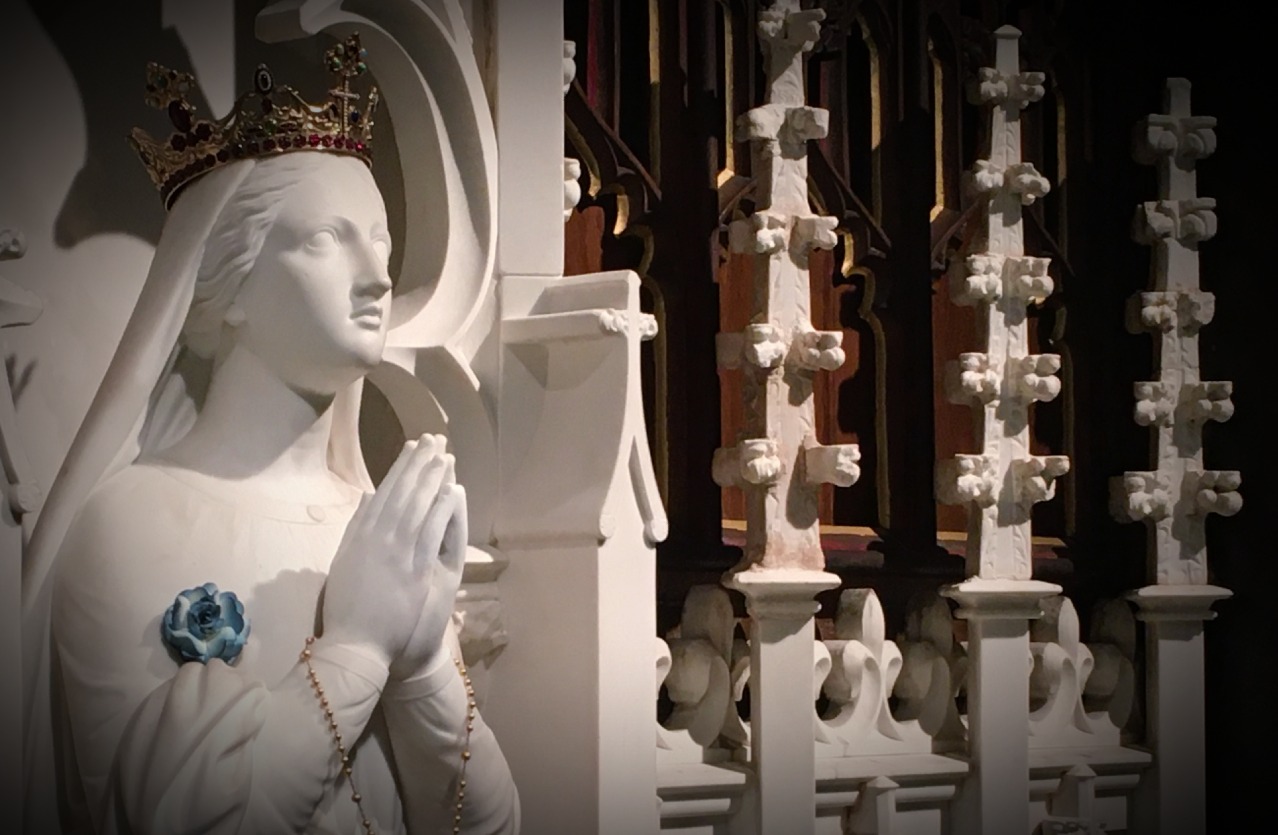
May 16, 1857The blessing of the Statue
of the Blessed
Virgin Mary of the Immaculate Conception.
April 27, 1860
Jesuits relinquish administration of the parish.

March 21, 1861Madame Anna Maria Huarte de Iturbide, the First Empress of Mexico,
dies and is buried in Vault IX of the Churchyard at the age of 79. Her husband, Mexican Emperor Augustin de
Iturbide, overthrew the Spanish rule, but General Santa Ana forced his abdication on March 19, 1823. The
Iturbide family was initially exiled to Italy. The former Emperor returned to Mexico to rally his forces,
was captured instead, and executed on July 19, 1824. His family moved to Philadelphia, where they lived on Spruce
St. near 13th, and later at 226 Broad St. A son Augustin J. Iturbide, a daughter, Sabina are also buried here.
Two additional (unnamed) children are reburied in the vault in 1849.
1864Cathedral opens near Logan Circle and St. John's reverts back to a parish.
The parish is becoming less residential and more of a business district.
1895
The original rectory is torn down and the current friary is built on the same site. By this time, John Wanamaker
has built a large retail store near the church and City Hall is being built nearby.Much of the neighborhood around
St. John's at this time is residences and small businesses.
February 16 - 17, 1899 A great fire burns part of the block around Market Street
and 13th Street. The church and part of the rectory are lost in the fire. Three firemen are killed fighting the
fire when a building collapses on them. A fourth fireman later dies of pneumonia, contracted while fighting the fire. After the blaze is extinguished, the Blessed Mother statue remains standing amid the rubble.
February 26, 1899 Mass for the
firemen killed in the fire is held at the Academy of Music.
September 10, 1899
The Sisters of St. Joseph assume responsibility for the school. The school is moved out of the
basement of the Church and from this time the basement is used as the Lower Church.
September 1899First parish bulletin, The Monitor is issued. The first bulletin notes the issue
of paying "pew rent." The school children received instruction for First Holy Communion at 3:30 in the
afternoon, while working children received their instruction at 8:00 PM. Fr. Fisher becomes the new pastor.
Among his innovations is 2:45 AM Sunday Morning Mass for night workers. Most of these were newspaper workers,
so the mass was known as the "Printer's Mass." The history notes that 300 workers were present for mass on
November 5th, 1904.
1902 The first Lower Church is opened,
dedicated to Our
Lady of Lourdes. The lower church was made possible by sinking the pillars supporting the main
church through the basement and into the ground. The basement floor was lowered three feet to accomodate the Lower Church.
Two openings at the front of the towers were made to access the Lower Church. The original basement
entered from the side of the south tower on Clover St., which is a window today.

1907
A major renovation of the Upper Church takes place to celebrate the diamond jubilee of St. John's.
The upper balconies are removed at this time and the exterior walls are covered with a facing of granite.
The towers are also extended higher.
1912 Fr. Fisher buys 1218 Vine
street for use as a day nursery.
January 1913 St John's is threatened by an underground river that was diverted into the foundation of
St John's by construction of the Adelphia Hotel. The river
undermines the foundation to the point of noticeable settling. The church is closed for three weeks for fear of
collapse.
1917 Father Lallou, one of the curates at St John's,
leaves St. John's for service in World War I. The parish bulletin attempts to track the names of all
of the men leaving for military service. Many of these names can be seen today on
the plaque in the graveyard.
1918 The influenza epidemic forces
the day nursery to close. In its place, a hospital for infants and children up to 7 years of age is
opened.
1920 After this time, St John's is less of a parish church and
more of a shrine church.
May 1920 Father Wastl becomes pastor. He institutes
regular weekly confessions on Thursdays to meet the needs of the "living-out girls" on their day off.
1924 The Holy Name Society of St John's becomes very active in setting up
athletic leagues (especially basketball).
1925 Sisters of the
Visitation are exiled during persecutions of the church in Mexico. They come to Philadelphia and
live in church property for several years before moving to their current monastery site on City Line
Avenue.
1929 With the onset of the Depression, St John's becomes active in
feeding the hungry. About 700 men per day are fed at St John's. The pastor, Monsignor Wastl, is given a
humanitarian award by Philadelphia, but declines to accept.
April 10, 1932
Centenary Mass is celebrated by the rector of St. Charles Seminary, Rt. Rev. Joseph Corrigan. He
describes St. John's as "a heart in the very breast of a great city, throbbing with faith and hope and
love."
1932 Msgr. Wastl counts 46,089 visitors to St. John's in one week
even though there are no special devotions.
January 1937 Msgr. Wastl
opens the Pamphlet Room in the rear of the basement, run by the Information League. It sells about 150,000
Catholic pamphlets a year, one of the largest services in the country. As part of their service, they take
questions on the Catholic faith. They average about 200 inquiries per week from across the country.
October 1, 1939 Daily Exposition of
the Blessed Sacrament begins.
1939 Bishop Yu Pin visits Philadelphia and
encourages the Chinese community to become involved in the Memorial Day services at St John's. Over 400
Chinese Catholics attend. So many Chinese become involved in St John's parish that a separate chapel of
St John's is created in Chinatown. This chapel later expands to Holy Redeemer Church, which is opened on
October 5, 1941.Fr. Tom Betz, the current Administrator of the chapel, resides at St. John's.
April 11, 1943
Msgr.Wastl dies. He served St John's for over 30 years.
April 1943
Fr. Kavanaugh becomes pastor. Among his innovations is the display box. Nine out of ten people who walk
along 13th street stop to see what is in the display box, usually an explanation of some church doctrine.
He also renovates the rectory, starts daily scheduled confessions, and installs air conditioning in the
Lower Church. He dies in 1949.
1951 Fr. Boyle becomes pastor.
He initiates the St. John's Night School for Adults, which later becomes the St. John's Evening School.
He dies in 1954 from a heart attack.
1959 Fr.
Anthony O'Neill becomes pastor. His concern for the poor and homeless in Center City
leads to the establishment of St. John's Hospice for Transient Men, which is blessed in September 1963.
1963 The Upper Church is redecorated and the lower chapel is renovated.
June 19, 1977 St. John Neumann is canonized.
1991 The Capuchin Franciscan Friars accept responsibility
for managing St. John's Parish. Fr. Greg Chervenak is pastor.
1995-1997
Fr. Fred Krause serves as pastor of St. John's.
1997-2001
Fr. Jim Menkhus serves as pastor of St. John's.
2001-2004
Fr. Francis X. Russo serves as pastor of St. John's.
August 28, 2004
Fr. Frank Yacobi becomes pastor. St. John's receives over 300,000 visitors per year.
2004-2005
St. John's celebrates its 175th Jubilee
February 16, 2008
St. John's institutes an annual Memorial Mass to honor the four firefighters killed as a result of the 1899 fire.
October 30, 2010
Fr. John Daya is installed as pastor of St. John's.